August 2025 - RedSeal

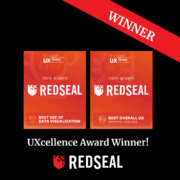
RedSeal Wins Two Top Honors at the 2025 UXcellence Awards

Las Vegas, NV – August 7, 2025 – RedSeal, a leader in proactive cybersecurity and exposure management, is thrilled to announce its win of two prestigious awards at the 2025 UXcellence Awards: Best Use of Data Visualization and Best Overall UX. These accolades recognize RedSeal’s commitment to transforming complex security data into clarity, context, and actionable guidance for security and IT teams.

A New Standard for Cybersecurity Visualization

RedSeal’s platform earned the Best Use of Data Visualization award for its ability to create a dynamic digital twin of an organization’s hybrid environment. This innovative approach enables organizations to visualize all reachable paths and exposed systems across complex on-premises, cloud, remote, and OT environments. The platform’s visualizations uncover hidden attack paths and calculate the Risk Radius™ — showing how far a threat actor could move from a compromised asset and what business impact could result. This capability helps security teams prioritize vulnerabilities based on real-world exploitability and business context, not just severity scores, allowing them to focus on the threats that matter most.

Elevating the User Experience

RedSeal was also honored with the Best Overall UX award, a testament to its modern and intuitive interface designed to empower faster, more informed decisions. Key innovations include a unified security posture dashboard featuring the Digital Resilience Score, a refreshed Vulnerability Dashboard with Risk RadiusTM prioritization that ties exploitability to business impact, and hop-by-hop attack path mapping. These features, developed with continuous user research and feedback, address the industry’s critical visibility gap, turning overwhelming data into actionable information.

“We are incredibly proud to be recognized by the UXcellence Awards for our work in making cybersecurity more intuitive and effective,” said Joseph Ward, SVP Products, RedSeal. “Our goal is to help customers protect what they can’t see. These awards validate our approach to turning complex hybrid environment data into visual, actionable intelligence, enabling security teams to strengthen their posture proactively.”

The platform’s impact has been recognized by customers who have seen significant improvements in their security operations. A director at a utility company noted, “Through RedSeal, we were able to reduce the time it takes to evaluate our systems for specific vulnerabilities from one person per month to 15 minutes. Now, we can spend our time on mitigation, rather than assessment.”

Navigating Complexity with Confidence

The new RedSeal One Platform, announced at Black Hat, features an enhanced user experience with a unified security posture dashboard, Risk Radius insights, and advanced filtering, giving cybersecurity teams the clarity and context needed to reduce risk across today’s complex digital environments. “We know that security professionals are often overwhelmed with data but underwhelmed by actionable intelligence,” continued Joseph. “RedSeal’s UX/UI innovations provide clear insights into an organization’s digital environment, allowing teams to move faster, make more informed decisions, and stop playing “whack-a-mole” with vulnerabilities.”

By empowering users to quickly identify and address the most critical risks, RedSeal ensures they can focus on what matters most: strengthening their security posture and protecting their business.

About RedSeal

RedSeal, a pioneer in preemptive exposure management and winner of the SC Award for Best CTEM Solution, helps organizations see, understand, and secure hybrid digital environments across IT, remote, OT, cloud, and IoT. Its patented modeling uncovers hidden assets, misconfigurations, and attack paths; prioritizes exposures by business-critical impact with Risk Radius™; and continuously validates compliance. Trusted by Fortune 1000 companies and U.S. military branches, RedSeal strengthens resilience, streamlines operations, and reduces business risk. Visit www.redseal.net.

About the UXcellence Awards

The UXcellence Awards recognize outstanding achievement in user experience and design. Judged by a panel of industry experts, the awards celebrate innovative products and solutions that make technology more intuitive, efficient, and impactful. They highlight companies that prioritize user-centric design to solve complex problems and create exceptional digital experiences.


OT Asset Inventory Made Practical: What the New NSA/CISA Guidance Means — and How to Get There

Bottom line: NSA, CISA, EPA, FBI, and allied cyber agencies just published prescriptive guidance for building and maintaining an OT asset inventory and taxonomy—the foundation for a modern, defensible OT architecture. If you already run RedSeal, you can fulfill most of the guidance quickly by modeling your hybrid networks, auto-grouping assets into OT zones, validating segmentation, and continuously monitoring drift. If you don’t have RedSeal, you can still make rapid progress with a pragmatic, manual-first playbook and a tight operating cadence.
What’s new and why it matters
On August 13, 2025, CISA—joined by NSA, EPA, FBI, and peer agencies from Australia, Canada, Germany, the Netherlands, and New Zealand—released Foundations for OT Cybersecurity: Asset Inventory Guidance for Owners and Operators. The goal: give OT owners/operators a systematic way to build an asset inventory plus a supplemental taxonomy that clarifies criticality, function, and dependencies so you can prioritize defenses and keep operations safe. CISA
NSA’s companion press note underscores the risk frame: OT systems are prime targets for disruption and extortion; the new process is meant to drive a modern defensible architecture by turning inventory and taxonomy into daily-operational tools for risk ID, vuln management, and incident response. NSA
What the guidance actually asks you to do
The document lays out a practical, repeatable sequence you can implement sector-by-sector or site-by-site:
  1. Define scope & objectives and establish governance for asset management.
  2. Identify assets across systems, hardware, and software (expect legacy protocols and walkdowns in plants).
  3. Collect attributes that matter for OT (function, location, firmware, network addressing, vendor, safety impact, etc.).
  4. Create an OT taxonomy that groups assets by function and criticality to support prioritization and reporting.
  5. Manage the data: normalize, de-duplicate, and choose a system of record.
  6. Implement lifecycle management so the inventory stays accurate as things change.
  7. Post-inventory actions: use the inventory for risk management, maintenance, KPIs/metrics, training, and continuous improvement.
  8. Sector examples (oil & gas, electricity, water/wastewater) are included as conceptual taxonomies to copy/adapt—not mandates.
How RedSeal helps you meet (and keep) the guidance
Translate the guidance into workflows you can run:
  • Asset discovery via configuration modeling (not intrusive scanning). RedSeal ingests device configs (routers, switches, firewalls, cloud constructs) to build a live model of reachable networks, subnets, and routes—including “dark” or unscanned subnets you didn’t know to ask for. That accelerates the “identify assets + collect attributes” steps without touching fragile OT endpoints.
  • Taxonomy & zoning you can defend. Use RedSeal to define OT zones (Level 0–3/3.5/DMZ), plants, safety systems, remote access enclaves, and vendor gateways; tag assets and subnets accordingly; and validate that traffic paths actually enforce those zones. This operationalizes the taxonomy requirement into policy you can measure.
  • Segmentation & path analysis. Instantly check which external sources (or IT enclaves) can reach specific PLC networks and over which ports/protocols; flag rules and devices enabling that access; and document required paths (e.g., historian to DMZ to IT) vs. prohibited paths. That directly supports the guide’s “use the inventory for risk management and incident response.”
  • Secure configuration baselines—maintained for you. RedSeal ships and maintains secure-config checks, so you’re not hand-authoring rules for every platform—closing the gap the guide calls out on governance and lifecycle.
  • Prioritization with context (Risk Radius). Combine model-based reachability with vuln data to focus on exploitable exposures that matter to operations and safety; quantify blast radius if a device is compromised to drive maintenance windows and remediation.
  • Continuous assurance. Schedule config pulls and policy checks to keep the inventory current and produce monthly KPIs (coverage, drift, # of prohibited paths removed, % of assets with required attributes, etc.) to satisfy the guidance’s “performance monitoring and reporting.”
Outcome: With RedSeal, most of the guidance becomes configuration-driven and repeatable, no fragile probes into Level 0/1, fewer site walkdowns, faster time to a defendable taxonomy, and continuous evidence for regulators, boards, and plant leadership.
Don’t have RedSeal? A pragmatic playbook you can start today
You can still execute the guidance with a manual-first approach and low risk to operations:
  1. Scope & governance (Week 0–1)
    • Name a single inventory owner; define change-control hooks.
    • Pick a system of record: a spreadsheet today; migrate to CMDB later.
    • Adopt a simple taxonomy starter: Site → Zone (L0–L3.5/DMZ) → Function (Safety, Control, Historians, Engineering Workstations) → Criticality (High/Med/Low).
  2. Collect the first 80% (Weeks 1–4) — no intrusive scanning
    • Export firewall rulebases and NATs; pull router/switch route tables, ARP, MAC, CDP/LLDP neighbors; harvest VLAN–subnet maps; gather DHCP scopes.
    • Pull vendor asset lists from maintenance systems and spare-parts logs.
    • Walk the floor once for safety-critical panels and “stranded” devices, using photos + serials.
    • Normalize names; assign each asset to Site/Zone/Function/Criticality; record minimum attributes (model, firmware, IP/subnet, last-seen source).
  3. Make it useful (Weeks 4–6)
    • From firewall exports, generate your first “Allow List to OT”: all sources, ports, protocols allowed into OT; which rules/devices enable them; and which OT zones they terminate in. Use it to remove obvious over-permissive rules.
    • Produce top 10 prohibited paths discovered (e.g., IT laptops → L2 networks).
    • Stand up monthly KPIs: % assets with required attributes; # of unknown subnets; # of over-permissive rules removed; % of OT zones with validated inter-zone policy.
  4. Sustain & improve (Months 2–6)
    • Establish a cadence: weekly delta-captures from firewalls/routers/switches; monthly plant review; quarterly taxonomy tune-up.
    • Map inventory to incident response playbooks (what to isolate, and how) and to maintenance windows.
    • Align with NIST SP 800-82 and CISA CPGs to show maturity progress to auditors and execs.
Tip: If you later adopt RedSeal, you can ingest the same config sources to automate the steps you were doing by hand—turning your spreadsheet into a live model with policy validation and continuous drift detection.
Example deliverables your board and plant managers will understand
  • One-page OT Taxonomy for your organization (zones, functions, criticality definitions, naming standards).
  • OT Allow-Into Report: “All IPs allowed into OT, by port/protocol, rule, device, and destination zone,” with owner and remediation recommendation.
  • Segmentation Scorecard: % of required inter-zone policies enforced; # of prohibited paths eliminated this month.
  • Risk & Maintenance Heatmap: assets by criticality × firmware currency × reachable-from-IT.
Where to start this week
  1. Adopt the official steps. Use the new guide to define scope, attributes, and your taxonomy; copy a sector example if it fits your environment. CISA
  2. Pick a discovery approach. RedSeal for model-based automation and continuous assurance; or a manual, low-impact sweep using configs and plant walkdowns.
  3. Publish the first “Allow-Into OT” list and remove one risky rule this week.
  4. Set KPIs and a 30/60/90 plan so progress is visible.
Sources
  • CISA: Foundations for OT Cybersecurity: Asset Inventory Guidance for Owners and Operators (published Aug. 13, 2025), including partner list and purpose. CISA
  • Guidance PDF: steps for inventory, taxonomy, sector examples, and post-inventory actions. CISA
  • NSA press release: context on threats and emphasis on defensible architecture/use of inventory. NSA
  • NIST SP 800-82r3: broader OT security control practices. NIST Publications
  • CISA Cybersecurity Performance Goals (CPGs): implementation and tracking framework. CISA

RedSeal Launches Risk Radius™ to Help Security Teams Focus on What Matters Most

New risk prioritization and impact analysis solution uniquely combines likelihood and business impact to streamline remediation and reduce cyber risk

Menlo Park, Calif. – August 6, 2025 – RedSeal, a pioneer in preemptive exposure management today announced the launch of RedSeal Risk Radius™, a next-generation risk prioritization and impact analysis solution designed to help security teams to quickly identify and remediate the exposures that have the greatest risk to their business.

In complex hybrid environments, security and network teams face an overwhelming number of vulnerabilities, far more than they can realistically investigate, or remediate. But not all risks are equal. Traditional approaches that rely on CVSS, EPSS, or other vulnerability-centric scores fail to account for critical context: how exposed an asset is, how valuable it is, and what would happen if it were compromised. Vulnerability scanners show what exists, but not what is truly exploitable — or which risks are actually reachable across on-premises, cloud, and hybrid environments. Without that context, teams waste time chasing noise while true risks go unaddressed. Risk Radius solves this by combining the likelihood of compromise with potential business impact, giving defenders a clear, actionable view of where the greatest risks live — and how to eliminate them efficiently.

“Security teams today are under immense pressure to secure sprawling, hybrid environments with fewer resources,” said Greg Enriquez, CEO of RedSeal. “Most tools stop at estimating how likely a system is to be compromised, but Risk Radius goes further – combining that likelihood with the potential impact of a breach. This gives teams the clarity and confidence to focus on the risks that matter most and to act knowing every fix delivers meaningful results.”

Unlike tools that separate prioritization from validation, Risk Radius includes an AI enhanced Risk Analysis capability that shows how each fix strengthens the environment. By eliminating guesswork and validating impact as part of the prioritization step, it streamlines collaboration across security and infrastructure teams and accelerates remediation with confidence.

“We designed Risk Radius to solve the biggest gap in risk prioritization: understanding not just what’s likely to be exploited, but what would actually hurt the business,” said Joseph Ward, SVP of Product at RedSeal. “By combining the likelihood of compromise and potential impact, Risk Radius enables lean teams to make smarter decisions, faster — even in the most complex hybrid environments.”

That impact is already being seen by RedSeal’s partners in the field.

“Risk Radius helps bridge the gap between security and network teams by clearly showing which risks matter most and why,” said Julia Xiang, General Manager at Merlin International. “This improves collaboration and accelerates response — a capability that’s in high demand among our customer base.”

Risk Radius is delivered as a core capability within the newly launched RedSeal One platform, which dynamically models hybrid digital environments to reveal hidden risks, misconfigurations, and attack paths. The platform integrates with more than 2,000 third-party security and infrastructure systems and devices, allowing Risk Radius insights to flow directly into existing IT and SecOps workflows—enhancing existing investments and improving operational ROI.

Whether supporting Zero Trust initiatives or continuous threat exposure management (CTEM) programs, Risk Radius helps organizations reduce cyber risk more effectively—without increasing headcount.

See Risk Radius in Action at Black Hat 2025

RedSeal will be showcasing Risk Radius at Booth #5827 during Black Hat USA, August 6–8 in Las Vegas. Attendees are invited to meet with RedSeal experts and see how the solution helps teams prioritize more effectively, collaborate faster, and remediate with confidence.

About RedSeal

RedSeal, a pioneer in preemptive exposure management and winner of the SC Award for Best CTEM Solution, helps organizations see, understand, and secure their hybrid digital environments—spanning IT, remote, OT, cloud, and IoT. By dynamically modeling the entire environment, RedSeal uncovers hidden assets, misconfigurations, and lateral attack paths; prioritizes exposures based on business-critical impact and Risk Radius; and continuously validates compliance with internal policies and industry standards. Trusted by hundreds of Fortune 1000 companies and more than 75 U.S. government agencies, including all five branches of the U.S. military, RedSeal strengthens resilience, streamlines operations, and reduces business risk. Visit www.redseal.net to learn more.


RedSeal Launches AI-Enabled RedSeal One Platform to Power preemptive exposure management Across Hybrid Environments

New platform unifies visibility, prioritization, and action with agentic AI to help organizations see and secure their entire digital terrain

Menlo Park, Calif. – August 5, 2025 – RedSeal, a pioneer in preemptive exposure management , today announced the launch of RedSeal One, an AI-enabled exposure management platform designed to help organizations reduce risk, streamline operations, and strengthen resilience across hybrid environments.

RedSeal One combines the company’s four foundational capabilities—hybrid environment modeling, attack path analysis, business-contextual risk prioritization, and continuous compliance—into a single, streamlined platform. Enabled by agentic AI, the platform continuously models the full hybrid digital environment and delivers actionable insights with the context teams need to reduce risk, validate defenses, and take informed action—faster and with greater confidence.

“As cyber threats become more dynamic and environments more complex, organizations can no longer afford to rely on fragmented tools and reactive strategies,” said Greg Enriquez, CEO of RedSeal. “RedSeal One is built for this moment—combining our proven capabilities with embedded agentic AI to deliver unified visibility, prioritized risk insights, and automated action across the hybrid enterprise. It’s a smarter, faster way to operationalize exposure management and strengthen resilience at scale.”

Built for Hybrid Complexity, Guided by AI

With the complexity of hybrid infrastructure—spanning IT, OT, cloud, remote, and IoT—security teams face increasing pressure to identify and act on what matters most. RedSeal One helps them do just that:

  • See the whole picture: Dynamically model the entire environment to uncover hidden assets, misconfigurations, and access paths that other tools miss.
  • Act with confidence: RedSeal One prioritizes exposures based on business impact and confirms the effectiveness of each fix through AI-informed impact validation.
  • Operationalize resilience with ease: RedSeal One delivers fast time-to-value through agentless deployment, deep integrations, and embedded insights that drive action across teams.

“RedSeal One is more than a platform—it’s a new foundation for proactive security,” said Joseph Ward, Vice President of Product at RedSeal. “By unifying RedSeal’s core capabilities and enhancing them with agentic AI, we help organizations not only identify risk but take the right action at the right time. From dynamic modeling to AI-orchestrated workflows, RedSeal One empowers security and IT teams to reduce risk with speed, clarity, and confidence.”

What Sets RedSeal One Apart

RedSeal One aligns with the vision of Exposure Assessment Platforms (EAP) and supports Continuous Threat Exposure Management (CTEM) programs. Highlights include:

  • Unified delivery of the platform’s four proven capabilities
  • Advanced risk prioritization and remediation validation based on business impact and exposure context
  • Integrated automation and workflow orchestration
  • Continuous modeling across IT, OT, cloud, remote, and IoT
  • Agentless deployment and fast operationalization
  • Integration with more than 2,000 third-party security and infrastructure systems and devices

“Most Legislative Branch agencies are navigating the transition from heavily on-prem environments to more hybrid cloud models. Visibility and risk prioritization remain major challenges,” said Tim Murphy, Director of Alliances at FCN Technologies. “RedSeal One is helping our customers bridge that gap by providing actionable insight into their evolving attack surface, making it easier to manage risk across both legacy and modern systems.”

See It at Black Hat

Heading to Black Hat? Visit RedSeal at Booth #5827 to see how RedSeal One uses agentic AI to uncover hidden exposures, validate defenses, and orchestrate security operations—all in one platform.

About RedSeal

RedSeal, a pioneer in preemptive exposure management and winner of the SC Award for Best CTEM Solution, helps organizations see, understand, and secure their hybrid digital environments—spanning IT, remote, OT, cloud, and IoT. By dynamically modeling the entire environment, RedSeal uncovers hidden assets, misconfigurations, and lateral attack paths; prioritizes exposures based on business-critical impact and Risk Radius; and continuously validates compliance with internal policies and industry standards. Trusted by hundreds of Fortune 1000 companies and more than 75 U.S. government agencies, including all five branches of the U.S. military, RedSeal strengthens resilience, streamlines operations, and reduces business risk. Visit www.redseal.net to learn more.

NEW Gartner® Report, Emerging Tech: The Future of Exposure Management is Preemptive.Download Report.