Enterprise environments are no longer contained within a single data center or cloud provider. They span on-premises networks, public and private clouds, remote locations, operational technology, Internet of Things devices, and third-party infrastructure. This complexity has changed what security teams need from an exposure management platform.
Traditional vulnerability management tools can identify weaknesses, but they often cannot explain whether an attacker can reach them, how exposures connect across the environment, or which issues create the greatest business risk.
Hybrid exposure management addresses this gap by helping organizations understand their entire environment as a connected system. It combines asset discovery, network modeling, attack path analysis, risk prioritization, compliance monitoring, and remediation workflows to reduce exposure before it becomes an incident.
Here are seven capabilities enterprise cybersecurity leaders should evaluate when selecting a hybrid exposure management platform.
- Hybrid Exposure Management Goes Beyond Vulnerability Scanning
A hybrid exposure management platform helps organizations identify, understand, prioritize, and reduce cybersecurity risk across interconnected environments.
Unlike traditional vulnerability management, exposure management does not evaluate vulnerabilities in isolation. It examines how assets, network configurations, identities, security controls, and business context interact.
This distinction matters because a high-severity vulnerability does not always represent the greatest risk.
A vulnerability may be difficult to exploit because it is isolated behind multiple security controls. At the same time, a lower-severity issue may provide a direct path to a critical system.
An effective exposure management platform should help answer questions such as:
- Can an attacker reach this asset?
- Which systems could be affected if it were compromised?
- What security controls stand between an attacker and a critical resource?
- Which exposures create the largest potential impact?
- What remediation would reduce the most risk?
By answering these questions, exposure management helps teams move from finding vulnerabilities to reducing meaningful risk.
- Complete Asset Discovery Is the Foundation
Organizations cannot protect assets they do not know exist.
Asset discovery is therefore one of the most important capabilities within an exposure management platform. However, discovery must extend beyond managed laptops, servers, and cloud workloads.
Enterprise environments frequently include:
- On-premises infrastructure
- Public and private cloud resources
- Remote offices and branch locations
- Virtual machines and containers
- Internet of Things devices
- Operational technology systems
- Network and security devices
- Unmanaged or unknown assets
IoT and OT security present a particular challenge because many devices cannot support traditional endpoint agents. Some are difficult to patch, run outdated operating systems, or support essential business and industrial processes that cannot easily be interrupted.
An exposure management platform designed for hybrid environments should use hybrid environment modeling to discover assets, map their connections, and provide visibility without depending entirely on agents. It should identify known and unknown assets, understand how they communicate, and show where they are located within the broader environment.
Complete asset discovery creates the foundation for every other exposure management capability. Without an accurate understanding of the environment, risk assessments and remediation decisions will remain incomplete.
- Architecture-Aware Visibility Is Essential
A list of assets does not show how an environment actually functions.
Enterprise cybersecurity leaders need architecture-aware visibility that explains the relationships between networks, assets, cloud environments, identities, routes, access controls, and security policies.
This is especially important for hybrid infrastructure security, where risk can move across multiple technology domains.
For example, an attacker might:
- Compromise an internet-facing system.
- Move through a misconfigured network segment.
- Use an identity relationship to access another environment.
- Reach a critical application or operational system.
Each individual security tool may see part of this activity. An exposure management platform should connect those individual findings into a unified model.
RedSeal creates a digital model of the hybrid environment by collecting and analyzing information from existing network, cloud, security, vulnerability, and identity technologies. This allows security teams to understand how the environment is configured and how an attacker could move through it.
By modeling the environment as a connected system, organizations gain more than visibility. They gain context.
- Attack Path Analysis Should Show How Risk Spreads
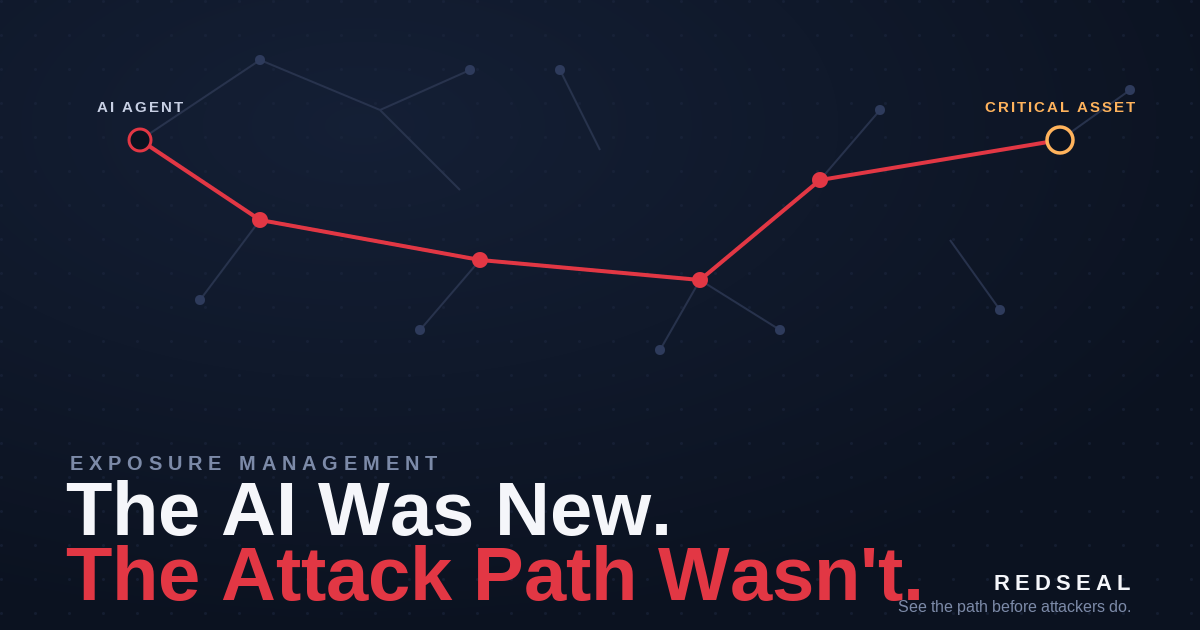
Attack path analysis helps security teams understand how an adversary could move from an initial point of access to a high-value asset.
Instead of presenting vulnerabilities as an isolated list, an exposure management platform should identify the combinations of exposures, routes, configurations, identities, and access policies that create viable attack paths.
This allows teams to answer a more valuable question:
What could an attacker actually reach?
Effective attack path analysis should show:
- Potential entry points
- Reachable assets and network segments
- Paths to critical systems
- Security controls along each path
- Opportunities for lateral movement
- Choke points where remediation could interrupt multiple paths
This context is particularly valuable in hybrid, IoT, and OT environments. Security teams may not be able to patch every vulnerable device immediately. In some cases, patching may not be possible at all.
Attack path reduction gives organizations additional ways to lower risk. Teams may be able to change network access, strengthen segmentation, adjust a security control, isolate an asset, or remove unnecessary connectivity.
The goal is not simply to count vulnerabilities. It is to reduce the number of ways an attacker can reach important systems.
- Risk Prioritization Must Include Business Impact
Security teams regularly face thousands or even millions of findings. Treating every vulnerability as equally urgent creates noise, slows remediation, and makes it harder to focus on the risks most likely to affect the business.
A mature exposure management platform should combine technical severity with environmental and business context.
That context may include:
- Asset criticality
- External exposure
- Network reachability
- Attack path position
- Existing security controls
- Exploitability
- Identity relationships
- Potential downstream impact
- Regulatory importance
- Business ownership
This approach improves threat reduction by helping teams focus on exposures that are both exploitable and consequential.
RedSeal’s Risk Radius risk prioritization helps organizations understand the potential impact of compromise by evaluating what an attacker could reach from a particular asset. Instead of prioritizing solely based on a vulnerability score, teams can consider the broader radius of risk surrounding the exposure.
For example, a vulnerable system connected to several critical applications may deserve attention before a higher-scoring vulnerability on an isolated device.
The best exposure management platforms help security leaders explain not only what needs to be fixed, but why it matters.
- Continuous Compliance Requires Continuous Validation
Compliance cannot be treated as a once-a-year assessment.
Hybrid environments change constantly. Cloud resources are added, network rules are updated, devices connect and disconnect, and configuration changes can unintentionally introduce new exposure.
Continuous compliance helps organizations identify policy violations and control gaps as the environment changes.
An exposure management platform should continuously assess the environment against internal policies, industry frameworks, and regulatory requirements. It should also help teams understand whether security controls are functioning as intended.
Key capabilities may include:
- Automated policy assessments
- Configuration validation
- Network segmentation checks
- Continuous control monitoring
- Evidence collection
- Compliance reporting
- Identification of policy violations
- Prioritized remediation guidance
Continuous compliance is especially important for organizations operating in highly regulated industries or managing critical infrastructure.
Rather than relying on point-in-time evidence, cybersecurity teams can maintain an ongoing understanding of their security posture and identify potential compliance issues before an audit.
- Exposure Management Should Support Action, Not Just Analysis
Visibility and prioritization provide limited value if security teams cannot turn findings into action.
An exposure management platform should connect analysis to remediation workflows. This means providing security, network, cloud, IT, and operational teams with clear information about what needs to change and why.
Effective workflow capabilities should help organizations:
- Assign remediation to the appropriate owner
- Provide technical and business context
- Track remediation progress
- Validate whether a change reduced risk
- Integrate with existing ticketing and security tools
- Automate repeatable response processes
- Measure changes in exposure over time
Exposure management should also help teams validate remediation before and after changes are made.
Before a change, teams should be able to understand its potential impact. After remediation, the platform should confirm that the exposure or attack path has actually been reduced.
This closes the gap between identifying risk and proving that risk has been addressed.
What Should You Look for in an Exposure Management Platform?
Enterprise cybersecurity leaders should evaluate whether a platform can provide the following capabilities across their complete environment:
- Comprehensive asset discovery
- Agentless visibility for hybrid, IoT, and OT environments
- Architecture-aware environment modeling
- Attack path and lateral movement analysis
- Business-contextual risk prioritization
- Continuous compliance monitoring
- Integrated remediation and validation workflows
The platform should also work with the organization’s existing technology investments. Exposure management should unify information from network, cloud, vulnerability, identity, endpoint, and security tools rather than create another disconnected source of alerts.
How Does RedSeal Support Hybrid Exposure Management?
RedSeal helps organizations understand and reduce exposure across complex hybrid environments.
The RedSeal exposure management platform creates an agentless digital model of the environment using information from existing network, cloud, security, vulnerability, and identity technologies.
This allows cybersecurity teams to:
- Discover assets across hybrid, IoT, and OT environments
- Understand network architecture and connectivity
- Identify attack paths and lateral movement opportunities
- Prioritize risk using environmental and business context
- Evaluate the potential impact of compromise with Risk Radius™
- Continuously monitor compliance and security controls
- Mobilize remediation through integrated workflows
- Validate whether security changes meaningfully reduced exposure
Instead of evaluating vulnerabilities as isolated findings, RedSeal helps organizations understand how risk moves through the environment and where action will have the greatest impact.
Reduce Exposure Across Your Hybrid Environment
The modern enterprise attack surface is too complex to manage through disconnected tools and vulnerability lists alone.
Organizations need an exposure management platform that can model the complete environment, reveal how risk is connected, prioritize the exposures that create the greatest potential impact, and help teams take action.
RedSeal gives cybersecurity leaders the visibility and context needed to understand their hybrid environment better than an adversary and reduce exposure before it becomes an incident.
Explore the RedSeal exposure management platform to see how your organization can uncover attack paths, prioritize meaningful risk, and strengthen security across hybrid IT, OT, and IoT environments.